

Story & Photos By Maria Sherow
In one of the most fertile places on earth, most of us still depend on ships crossing the Pacific Ocean to feed us. That gap between what is possible and what we have accepted is where this conversation begins.
There is a quiet contradiction at the heart of daily life in Puna. The shelves at the grocery store appear full, yet the prices keep climbing. The produce looks fresh, yet it has traveled thousands of miles to reach you. What looks like abundance is, in truth, distance. What feels like security is a long chain of dependencies, each one a link you never chose and cannot control.
When food must cross the ocean before it reaches your plate, its cost is shaped by everything required to move it. Fuel prices rise. Shipping schedules tighten. And suddenly, what once felt stable reveals its fragility. These are not abstract economic forces. They show up as higher grocery bills and a growing unease that something essential about your life is outside your control. The issue is not simply price. It is the quiet loss of agency that comes with complete reliance on systems you did not build and cannot influence.
Yet the deeper truth, which is easy to overlook when you are busy surviving, is that Puna is not a place of scarcity. It is a place of extraordinary growing potential. With year-round warmth and generous rainfall, this region offers something that much of the world does not have access to. Food can grow here continuously. In backyards, along fence lines, beside driveways, woven into the landscape, and in the quiet spaces that go unused every single day.
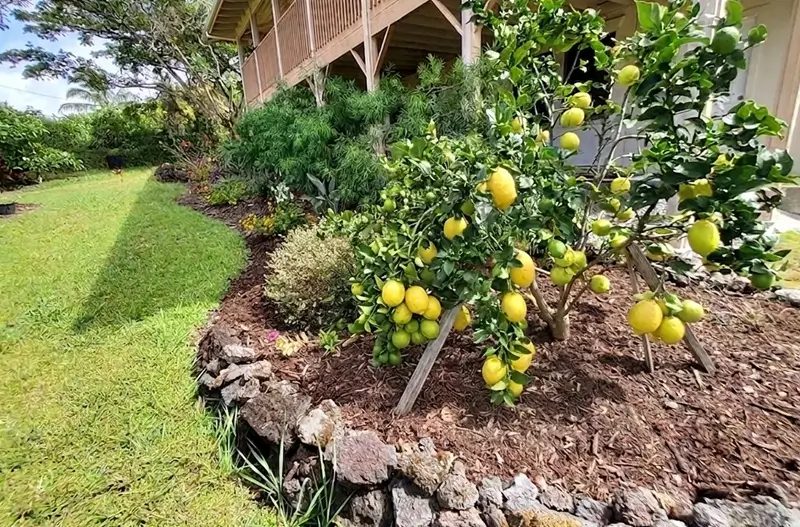
“A single fruit tree, after its initial care, can produce for years. That kind of return does not depend on a ship arriving on time.”
This is not a call for everyone to become a farmer. It is an invitation to reconsider what it means to participate in your own nourishment. Because when a single fruit tree begins to produce, it does not do so once. It offers food repeatedly, with a consistency that no supply chain can guarantee. When a small garden bed begins to yield greens or root vegetables, it does not replace the grocery store. But it changes your relationship to it. Your dependence decreases. Your sense of choice expands.
History shows us this pattern clearly. In moments when formal systems strain or fail, people do not begin by building something new. They return to what they can grow. Across different cultures and eras, whenever communities have faced economic disruption or supply shortages, ordinary people have turned available land into a source of security. What matters in those moments is not scale, but participation. What matters is not perfection, but commitment.
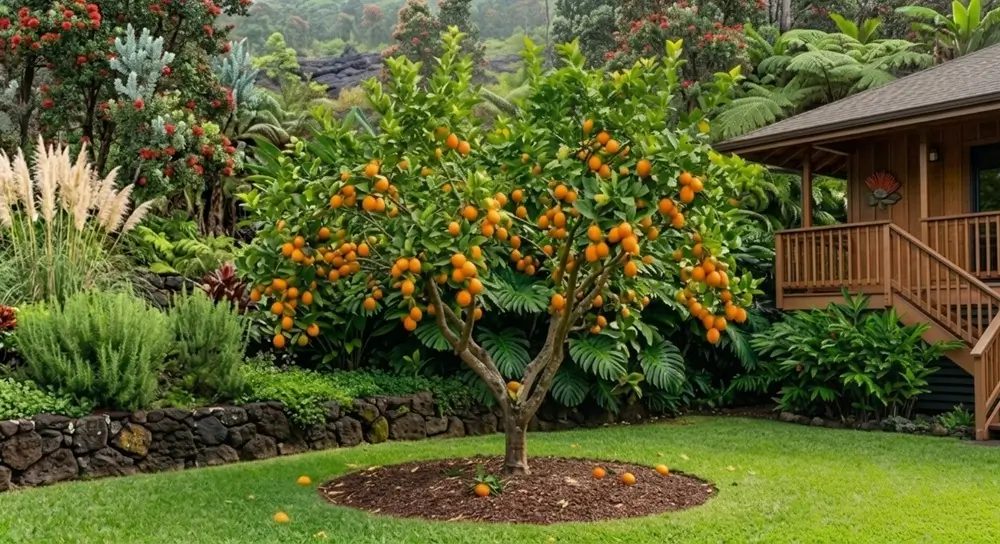
Here in Puna, many residents are already living this reality. There are yards where tangerine trees lean heavy with fruit and where banana patches multiply without much encouragement. One fruit tree will often offer more than one household can consume. There are homes where sweet potatoes spread across the ground and where herbs grow within reach of the kitchen. A handful of chickens can provide eggs with regularity that no price increase can interrupt. These are not rare exceptions. They are reminders of what is possible, and they exist all around us if we choose to look.

And yet there are also many properties where the land sits largely unused. It’s where grass or lava rock occupies space that could be producing food. It’s where the idea of growing something feels complicated or meant for someone else. It is here that the most important shift happens. Because the barrier is seldom the land itself. It is the belief that you must do everything to justify doing anything.
“When people grow food, they often begin to share it. Food becomes not only sustenance, but connection.”
The truth is quieter and more forgiving than that. A single tree or a small raised bed matters. Even a few containers on a lanai matter. When you plant something that feeds you, you begin stepping out of a system that requires constant purchasing and into one that offers ongoing return. Over time, these small decisions accumulate, not only as food on your table, but as knowledge in your hands and resilience in your household.
There is also a financial reality worth naming. While the cost of groceries continues to rise, the cost of growing, once established, tends to move in the opposite direction. A fruit tree, after its initial care, can produce for years. Herbs and greens, once established, can be harvested repeatedly. Even a little bit of growing can save you real money each week. And unlike grocery prices, it’s something you can count on. This is not a small thing when budgets are already strained.
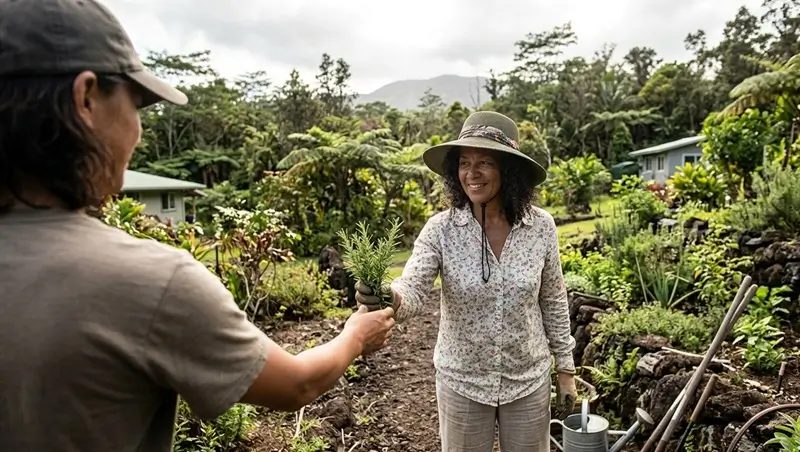
Perhaps more importantly, something relational begins to happen when people grow food. They start to share it. In many parts of Puna, this is already common: neighbors exchanging fruit, offering cuttings, trading seeds, lending tools, and passing along knowledge about what grows well. This informal network makes the whole community stronger, even though no one’s in charge of it. You can’t get this kind of trust from an organization. It only comes from neighbors helping each other. Food, in this sense, becomes more than sustenance. It becomes a way of being in relationship with one another and with the land itself.
The question, then, is not whether you can grow all of your food. Very few people do. The question is whether you are willing to grow some of it. Because in doing so, you reduce your exposure to rising costs and you participate in a form of security that does not depend on imports.
There is no perfect time to begin. Waiting for ideal conditions often means not beginning at all. The best way to begin is to start small, with something you will eat. Let the process teach you.

In Puna, the land still offers what it always has. The opportunity is already here, present in the climate and in the examples growing all around us. The only question is whether we choose to participate now, while the choice feels easy, or later, when the need feels urgent.
“You do not need to grow everything. But growing something changes everything.”
If you’re not sure where to start, the next article is for you.

Maria Sherow
MARIA SHEROW has been a lower Puna resident since 2013. A Quantum Healing Hypnosis Technique (QHHT) practitioner and the founder of the Kind Talk Project, Maria also shares weekly insights on her Substack newsletter. There, she explores the transformative power of kindness, QHHT, Gene Keys, and Nonviolent Communication, offering inspiring stories, practical guidance, and wisdom to help readers transform their relationships and find inner peace.
https://MariaSherow.substack.com