

Story & Photos, By Ekahi Aloha Dale Michaels
Editor’s Note: We welcome our newest columnist, Dale ‘Ekahi’ Michaels, a longtime Hawaii resident living his dream in the Kehena area. He knows everything going on there and will keep us updated.
~
Descending the cliffside trail to Kehena Bay’s black sand beach, you’ll pass a Heart—formed from pieces of broken brain coral.
The Heart is a universal symbol of love, welcoming all who arrive to enjoy the pristine blue waters of Mother Ocean, the jet-black volcanic sand, and the powerful elements that shape this extraordinary bay.

At the bottom of the trail is a familiar rock formation I call “Menehune Backstroke.” It looks like a giant lying on their back, resting at the edge of the sea—one of many natural features that seem alive if you take a moment to notice.

To the right, toward the Kalapana side, is what locals call the South Bay. Swimming there is not recommended—for anyone. There have been many rescues from this area. People get trapped, pummeled repeatedly against the rocky reef, and are unable to swim back around into the main bay.
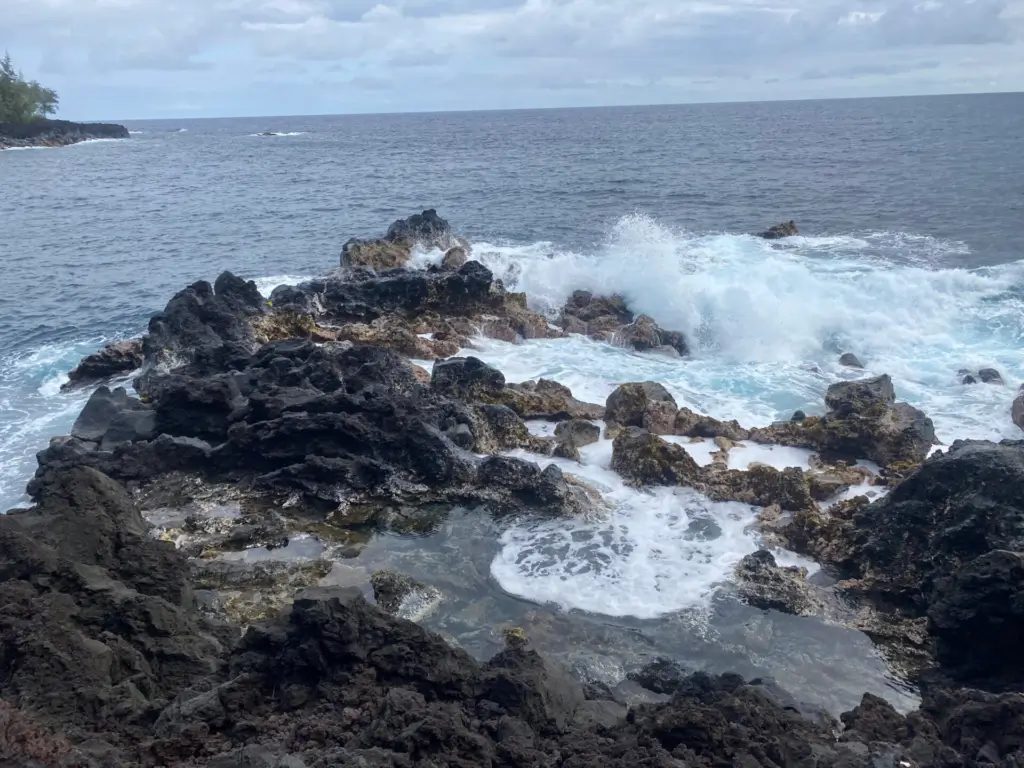
Kehena has no lifeguards. Swimming here is always at your own risk. Conditions can include strong currents, long stretches of whitewater, powerful undertow, large incoming waves, and constantly shifting rocks and boulders.
Just three weeks ago, an Asian tourist was caught in the South Bay. A regular beachgoer named Peterson was heading up the trail when he heard cries for help. He immediately ran toward the ocean and alerted the only two people on the beach at the time—myself and “Coconut” Jeff.
Jeff reacted instantly, swimming out and around into the South Bay. The exhausted tourist was barely able to keep his head above water. Jeff grabbed his arm and, with great effort, towed him back into the bay. Once ashore, four people—one on each limb—helped pull him safely onto the beach.
Last week, on an unusually calm day, two Hispanic tourists also needed rescue from the South Bay. One was clinging to a rocky outcrop while the other was being repeatedly smashed into the reef. Thanks to the quick response of four Kehena regulars—Neal, Swami Steve, Nai‘a Rae, and myself—both were brought back safely. Paramedics were called, and emergency services arrived.
Were it not for locals being present, these rescues would likely have ended very differently.
A few words of advice for anyone entering the water at Kehena: even strong, experienced swimmers exercise great caution here. Waves arrive in sets. It may look calm, but a larger set can follow without warning. Take time to observe the rhythm of the ocean.
Walk the length of the beach and choose the sandiest entry and exit point with the fewest exposed rocks. This matters.
I always ask Mother Ocean for help—both going in and coming out. She listens. If waves are present, wait until a set passes and enter during the lull. Getting in is easier; getting out requires patience, awareness, and humility.
When exiting, I line myself up with the same sandy spot I entered. Areas where people are standing in shallow water, or where boogie boarders and body surfers gather, are often safer exits.
Never turn your back on the ocean. I float on my back, watching, staying in harmony with her movements.
Kehena Bay is breathtaking—but it demands presence. Rogue waves can grab towels, sweep belongings away, or knock people down even while walking the shoreline.

Be safe. Have fun. And enjoy the pristine beauty of being in nature—with respect.

Ekahi Aloha Dale Michaels
EKAHI ALOHA DALE MICHAELS has been a lower Puna resident since 2014. He's 76 years 'young,' and loves deep ocean swimming, which is aligned with overall health consciousness. He's been a licensed healthcare practitioner (L.Ac.) since 1994 and a Hawai'i resident for 50 years. He loves swimming, preparing wholesome, nutritious, and delicious organic foods, enjoys ecstatic dance and all music in general, yoga stretching, and is an advocate for spending time in nature, walking, and hiking.
The origin of the name “ Kehena” comes from the Hawaiian word which translates as “ Kehena ( translated by Mary Kawena Pukui author Hawaiian Dictionary)
Kehena is a place name in the Puna district of Hawaiʻi Island, known as the location of Kehena Beach.
In Hawaiian, it refers to a “place of refuse” or “refuse pile” (sometimes spelled Kehena or Ke-hena). ” other root words ( from Sanskrit which many Hawaiian words have direct connection and meaning is “ Gehenna” Sanskrit term to describe “ Ge
In India’s historical context, Gehenna symbolizes a metaphorical representation of suffering and trials that individuals must navigate for personal growth and peace. This concept is particularly referenced in relation to Tummalapalli’s work, suggesting that overcoming these challenges is essential in one’s journey towards achieving a more profound sense of fulfillment and tranquility. The idea emphasizes the importance of resilience in facing difficulties as a pathway to personal development.
Synonyms: Hell, Abyss, Inferno, Underworld, Perdition, Sheol
The word Gehena is also Greek Hebrew with a similar meaning. Literal Origin: Derived from the Hebrew Gēʾ ḇen-Hīnnōm, meaning “Valley of the Son of Hinnom” or Valley of Hinnom.
Location: A valley south/southwest of Jerusalem.
Symbolism: Originally a place of child sacrifice (Tophet) in the Old Testament, it was later cursed by Jeremiah. In the New Testament, it is used by Jesus as a metaphor for the “final destruction” or “hellfire” (often in contrast to the more neutral Sheol or Hades).
Great article Ekahi! See ya at the beach.
Mark